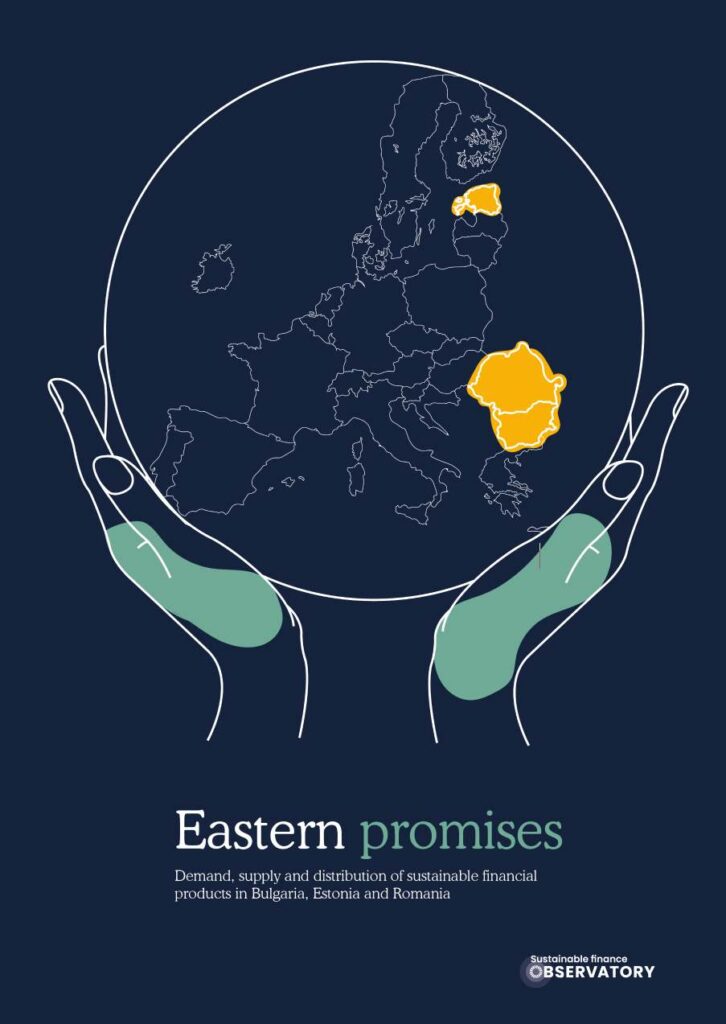


The report examines the structural barriers which hinder retail sustainable finance from reaching its potential in Bulgaria, Estonia, and Romania.
Between 2017 and 2025, the Sustainable Finance Observatory (SFO) has conducted one of the EU’s largest research programmes examining the demand, distribution and supply of sustainable financial products across 14 Member States. The findings show that national contexts differ significantly – and that these differences are critical to understanding how EU regulatory reforms aimed at channelling retail investment toward sustainable activities are implemented in practice.
Evidence from Bulgaria, Estonia and Romania shows that retail investor demand for sustainable finance exists but market conditions prevent this demand from being realised. The five thematic trends observed are:
- High awareness but low allocation: Awareness of sustainable financial products is high and future investment intentions are strong across all three countries. However, current allocation remains low. A persistent attitude–behaviour gap exists, driven not by a lack of interest among retail investors but by frictions elsewhere in the retail investment chain.
- Strong sustainability objectives: Retail investors consistently express strong sustainability objectives for both value alignment and impact. This indicates significant untapped market potential for sustainable financial products if this intention can be effectively leveraged.
- Misunderstanding of sustainable finance concepts: Widespread retail investor misunderstanding of key concepts, especially around impact mechanisms and the real-world effects of sustainable financial products, undermines this market potential.
- Limited availability of sustainable financial products: Access to sustainable financial products, particularly Article 9 funds, is restricted compared to larger financial markets. This limited choice constrains innovation and limits the ability of financial institutions to fully comply with EU product governance and suitability rules.
- Weak sustainability advisory processes: The financial advisory process is not functioning as the regulatory framework intended. The evidence suggests that retail investors in these countries face a lower-quality sustainability advisory process compared with the EU average. Financial advisors rarely initiate sustainability discussions. When discussions occur, advisor knowledge on sustainable finance is lower than on conventional investment topics. As a result, sustainability preferences are not systematically elicited and are not factored into financial product recommendations.
If EU policies are primarily designed around large Western markets, smaller Central and Eastern European markets may struggle to comply. To mobilise retail capital toward sustainable economic activities, policies must address these structural asymmetries.
Based on the in-country findings, the following interventions are recommended:
- Expand local financial product supply to increase investor choice.
- Strengthen supervisory expectations on assessing sustainability preferences.
- Invest in advisor training to improve sustainable finance knowledge and recommendations.
- Deliver targeted retail investor education to address knowledge gaps on impact, labelling and greenwashing.
Without target action, the promise of retail sustainable finance in the EU will remain uneven. Significant volumes of retail capital risk being misallocated, and smaller markets may be left behind. Targeted action is essential to unlock the full potential of retail investment in sustainable growth across the EU.
This project is part of the European Climate Initiative (EUKI) of the German Federal Ministry for the Environment, Climate Action, Nature Conservation and Nuclear Safety (BMUKN).