WHO WE ARE
The Sustainable Finance Observatory is an international, independent think tank specialised in mobilising private finance for a sustainable transition.
The organisation is the result of the merger of the international think tank 2° Investing Initiative which has been a pioneering think tank in supporting private financiers on climate alignment and impact investing since 2012 and the “Observatoire de la finance durable,” an initiative of the French Finance and Economy Minister.
Our mission is to encourage changes in financial practices and develop financing solutions to support a
sustainable, low-carbon economy. We adopt a pragmatic approach based on studies, tools and methodologies to directly benefit public and private actors and make a real impact on the economy.
We deliver a wide range of activities, including conducting research, data analysis and tool development, expertise and capacity building, coordinating and participating in multistakeholder coalitions, as well as leading advocacy campaigns.
These activities are structured around three core pillars: Transparency, Impact, and Bankable Sustainable Solutions.
We occupy a unique position across the entire finance value chain on both, the supply side (financial institutions) and the demand side (real economy). We deliver data, analysis, tools, expertise and advocacy on both:
- Transitioning finance by supporting and monitoring private financial institutions’ net-zero and
ESG commitments, enhancing transparency, and assessing the impact of financial flows — including savings — on the real economy; and - Financing the transition by deploying financial engineering to build sustainable bankable
solutions to attract private capital at scale in key areas for climate mitigation and adaptation.
The Sustainable Finance Observatory’s team includes experienced former bankers and financiers, as well as sustainable finance and legal analysts. Our work is supported by a Scientific and Expert Committee composed of some fifty senior sustainable finance academics and practitioners. This specialised finance expertise is key to us being able to deliver high-quality research and build bankable solutions for a transformative impact.
AREAS OF INTERVENTION
Among the fields covered by the think tank are:
Transparency, data, and regulatory analysis – Since 2020, Sustainable Finance Observatory has been monitoring ESG commitments of the Paris Financial Center stakeholders (banks, insurance companies, asset managers etc.). It releases official reports on financial disclosure at the French and European levels, such as the analysis of “net-zero” transition plans of European signatories of the Net-Zero Banking Alliance NZBA. It co-led, together with ADEME, the Climate Transparency Hub Report, analysing 29 LEC reports from 919 French financial institutions related to their mandatory ESG disclosures.
Retail Investing – Sustainable Finance Observatory works on reallocating individual savings to finance the low-carbon transition by helping financial institutions improve the sustainability of their products and devising policy recommendations. This stream covers 15,500 European funds (Austria, Belgium, Bulgaria, Croatia, Cyprus, Czech Republic, Denmark, Estonia, Finland, France, Germany, Greece, Hungary, Ireland, Italy, Latvia, Lithuania, Luxembourg, Malta, Netherlands, Poland, Portugal, Romania, Slovakia, Slovenia, Spain, Sweden, Switzerland, United Kingdom).
Impact Programme – Sustainable Finance Observatory has conducted pioneering work on ways that financial institutions can contribute to real-world emissions reductions beyond climate alignment. It has produced methodological tools, such as an impact management system, as well as an international standard for assessing and reporting green finance activities (ISO 14097). It currently works on Artificial Intelligence solutions for climate impact.
Adaptation and Biodiversity Finance – Sustainable Finance Observatory supports research and policy work on developing a Nature-Positive Economy, as well as the development of financial models for Nature-Based Solutions (NBS) in cities.
Energy Efficiency in Buildings – Sustainable Finance Observatory supports mass investment in energy-efficient building renovation through removing financial barriers within the overall ecosystem involving public administrations, property owners, banks, and non-financial private actors, both for residential and commercial buildings.
Emerging Market Programme – Sustainable Finance Observatory supports financial institutions in developing and emerging markets to align their activities with the goals of the Paris Agreement. It also conducts global work on climate alignment in public development banks.
Transition Plans – Sustainable Finance Observatory assists financial institutions in monitoring and analyzing their transition plans.
SELECTION OF PROJECTS
Net-Zero Donut – The Net-Zero Donut is an exclusive analytical framework for monitoring and assessing the climate strategies of financial institutions.
PACTA – The Paris Agreement Capital Transition Assessment (PACTA) is a free, open-source methodology and tool, which measures financial portfolios’ alignment with various climate scenarios consistent with the Paris Agreement.
MyFairMoney – MyFairMoney is a free, independent, non-profit platform helping retail investors to take sustainability into account and invest in line with their values.
Impact Potential Assessment Framework (IPAF) – The IPAF is a science-based framework to assess the impact potential of financial products.
FiRéno+ – The project aims to increase investment in energy-efficient building renovation and the integration of renewable energies in mainland France and the French overseas territories. The project seeks to overcome the barriers to financing energy-efficient renovations and small-scale integrated renewables (SSIR), as well as the challenges of a lack of collaboration between the players in the sector (public authorities and agencies, the non-financial private sector, the financial sector, homeowners). By fostering coordinated actions and targeted investments, it seeks to accelerate the energy transition in buildings through the development of new financing solutions and capacity-building based on turnkey proposals.
GoNature Positive! – This 4-year EU-funded project delivers a clear definition and conceptual framework for a Nature-Positive Economy (NPE), a roadmap proposing policy and governance pathways towards an NPE, blueprints for ground-breaking solutions to stubborn roadblocks, and demonstrations of what an NPE could look like on the ground.
RISE-IN – Resilient Investment for Sustainable Environments (RISE-IN). This a 5-year EUR 9 million EU funded project, focuses on designing new bankable financing solutions for adaptation and resilience to climate change. It supports assessing climate-resilient solutions, such as Nature-Based solutions in cities, ecosystem-based approaches, and physical measures, while mapping their co-benefits and identifying funding opportunities. The evaluation of the solutions incorporates 3 climate risk models to mitigate uncertainty around extreme events, water run-off, and capital loss. These solutions will be implemented in pilot cities.
Establishing a Transition Management System for the Energy Sector” for WWF Singapore – This Guidance is designed to support ASEAN banks and asset managers to increase their transition finance actions and ensure these transition finance actions effectively contribute to the net-zero transition of the ASEAN economy by 2050.
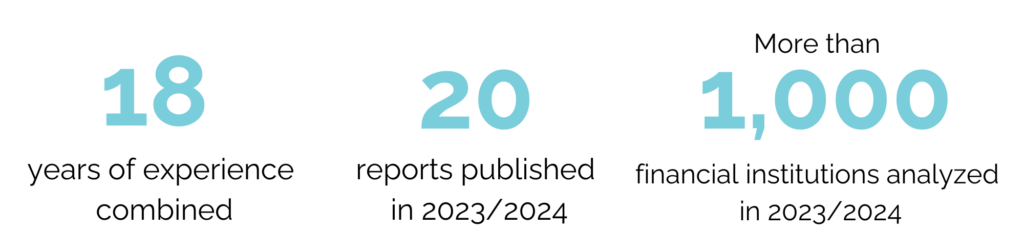
KEY FIGURES
LATEST PUBLICATIONS
Find out more about the latest publications and reports of Sustainable Finance Observatory here.
PARTNERS
Sustainable Finance Observatory works closely with a multitude of partners and funders, whose contributions are essential to the realisation of our projects. Here are some of our key partners: